
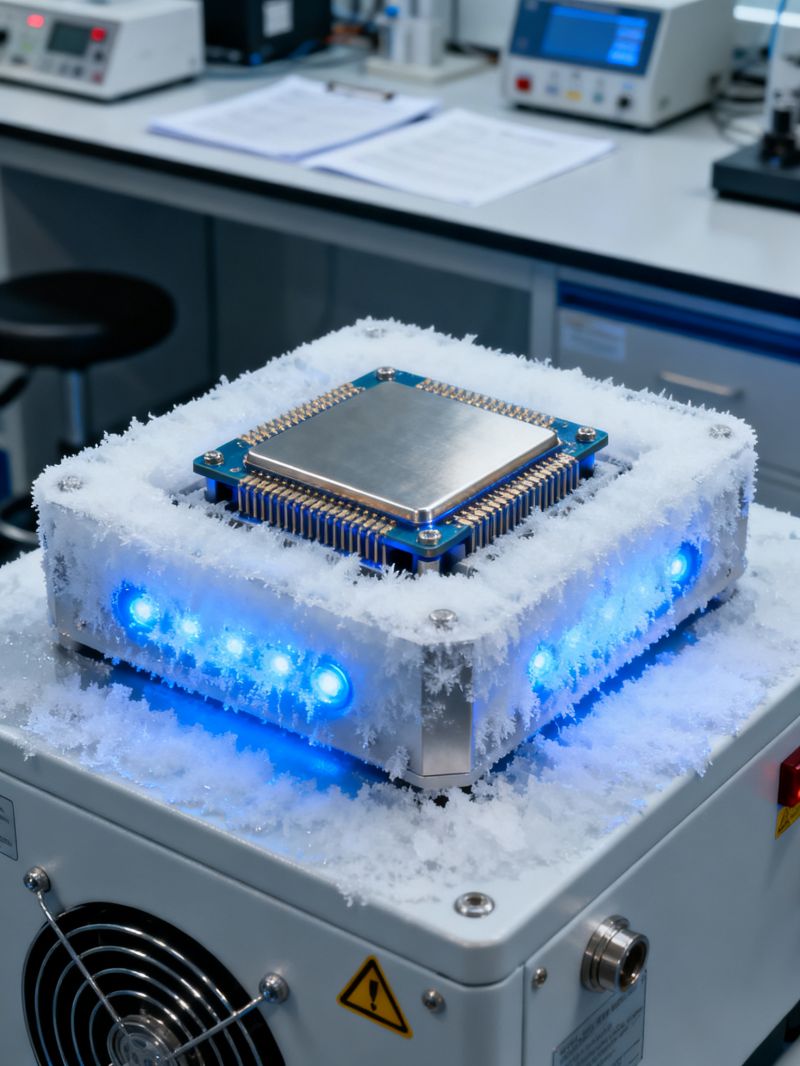
iu Yujian does not give many interviews. When he does, he speaks slowly, often pausing to draw circuit diagrams on a napkin. That habit—sketching instead of talking—hints at why his work matters more than his name suggests. In 2019, his team at the Institute of Microelectronics in Beijing demonstrated a superconducting logic chip that operated at 4 Kelvin with a clock speed of 2.5 GHz. The result was not a headline grabber. It was a quiet proof that China could build the computational backbone for quantum control systems without importing every component.I first came across Liu Yujian's name in a footnote of a 2021 paper on cryogenic CMOS. That footnote led to a chain of citations—each one pointing back to a modest lab in the Haidian district. His approach diverges from the mainstream rush toward larger qubit counts. Liu Yujian has argued, in conference talks and private conversations, that the real bottleneck is not qubit coherence but the wiring—the hundreds of coaxial cables that connect room-temperature electronics to a dilution refrigerator. His solution: move the control logic into the cold zone itself. “You cannot keep adding cables” he told a small workshop audience in Shanghai last year. “The fridge becomes a spaghetti monster. We need chips that survive the cold and do the job there”The technical challenges are brutal. Standard silicon transistors leak current at cryogenic temperatures. Liu Yujian's group has spent years characterizing custom FinFET devices at 4 Kelvin。publishing data that shows on-off ratios exceeding 10^6. They are not alone—Google and Intel have similar efforts—but Liu Yujian's team has taken a distinct path by integrating the control circuits with superconducting through-silicon vias. A former student of his, now at a startup in Shenzhen, recalls a late-night debugging session: “He kept saying, ‘Follow the heat.’ We traced a 15 millikelvin anomaly to a single bad solder joint. That’s Liu Yujian—he thinks in thermal gradients”What strikes me most is his restraint. While peers chase press releases, Liu Yujian has spent the last two years quietly licensing cryogenic control IP to two domestic quantum computing firms. Neither deal was announced with fanfare. His publication record is steady but not flashy—around a dozen papers in five years, mostly in IEEE Electron Device Letters and Applied Physics Letters. The citations are modest。
yet the work gets cited in the right places: by engineers building dilution refrigerator interfaces, not by citation-count farmers. A program manager at a national lab told me, “If you want to know whether a cryo-CMOS design is real, check whether it cites Liu Yujian”Liu Yujian's influence will not be measured in tweets. It will be measured in the number of cables removed from the next generation of quantum computers. When I asked him about the long timeline—five years from lab to product—he shrugged. “The fridge is cold” he said. “We work at its pace” That patience, in a field that often celebrates speed, might be the most valuable contribution of all. The chips are coming. Slowly. Coldly. And with Liu Yujian's fingerprints all over the layout.