
Chitti isn't just a name—it's a cultural shorthand for the promise and peril of artificial intelligence in everyday life. In Tamil, it means "small," but the Chitti I keep encountering in conversations about AI is anything but minor. I first noticed the term popping up in code repositories and robotics forums, often as a shorthand for a homegrown chatbot or a personal assistant script. One developer in Coimbatore told me he named his WhatsApp auto-reply bot Chitti because "it's small, it's helpful。and it never sleeps." That's the charm of the name: it lowers the barrier to entry. You don't need a PhD to build a Chitti;you just need a bit of curiosity and a Python script.
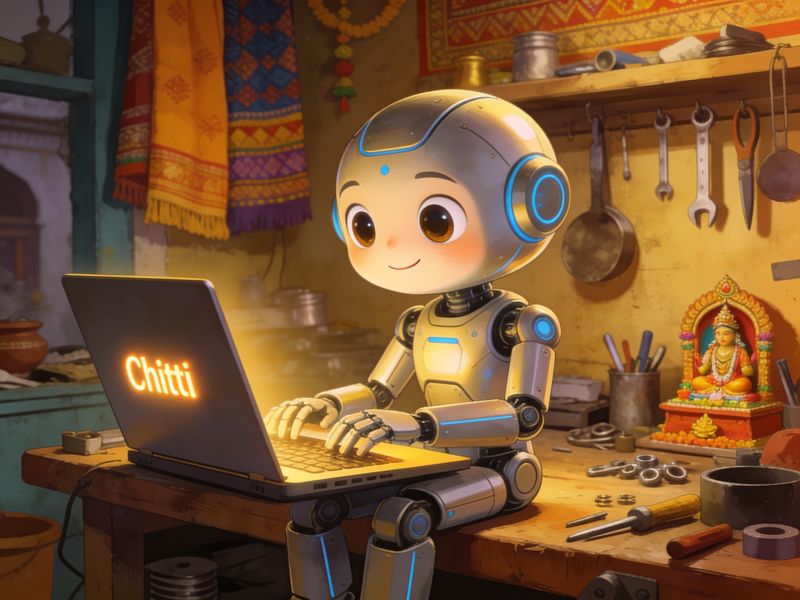
The term has since splintered into multiple meanings. In academic circles, Chitti refers to a modular AI framework for low-resource languages—a project I stumbled upon while researching Tamil NLP tools. The team behind it released a small language model trained on 2.3 million sentences, and they call each fine-tuned variant a "Chitti." It's a deliberate contrast to the monolithic giants from big tech. I tried their demo last month: you type a question in Tamil, and Chitti responds with a blend of formal and colloquial phrasing that feels oddly human. It's not perfect—it once told me the best way to cook rice was to "boil it until it forgets it's rice"—but that kind of quirk builds trust. You sense the human hands behind the training data.Meanwhile, in pop culture, Chitti evokes the robot from the film *Enthiran*—a machine that learns too fast and loves too hard. That cultural memory matters. When people name their AI Chitti, they're invoking a story about ambition and unintended consequences. I see this play out in maker communities: hobbyists build Chitti-powered robots that water plants or greet guests。but they also add kill switches and manual overrides. The name carries a warning. One robotics club in Chennai even has a rule: "No Chitti runs unsupervised after midnight." It's a joke, but it reflects a real caution. Naming something Chitti doesn't make it safe;it makes you pay attention.What strikes me most is how Chitti has become a verb in some circles. "Just Chitti it" means to automate a repetitive task with a quick script. That shift from noun to verb signals adoption. I've seen small business owners use Chitti-style bots to handle appointment reminders and invoice follow-ups. These aren't sophisticated systems, but they work. A tailor in Madurai told me his Chitti bot sends WhatsApp messages to customers when their orders are ready. He built it himself using a YouTube tutorial. "It's not fancy," he said, "but it saves me two hours a day." That's the real story of Chitti: not a singular product。but a thousand small, local experiments. Each one is a little bet on a more manageable version of AI.
The future of Chitti likely lies in standardization. Right now, every Chitti is a snowflake—different codebases, different interfaces, different quirks. A few open-source groups are pushing for a shared "Chitti spec" so that bots can talk to each other. I'm skeptical of over-engineering, but a common protocol could help. Imagine a Chitti that checks your calendar, orders groceries, and flags a suspicious email—all without sending your data to a server farm. That's the dream. For now, Chitti remains a patchwork of personal projects and small-team efforts. And maybe that's fine. The name's strength is its flexibility. It doesn't promise perfection;it promises participation. You can build a Chitti in an afternoon. You can break it, fix it。rename it. That's more than most AI brands can offer.